“To Every Black Woman in Menopause I Told That a Little Thinning Was Normal: I Owe You an Apology. I Was Wrong — and I Didn't Find Out Until It Was My Own Crown Disappearing in the Mirror.”
The 20 years I spent giving the wrong answer — and the one thing I found that finally rebuilds what menopause takes from a Black woman's hair, after everything else only ever covered it up.

I was the doctor giving that answer. For 20 years. Until menopause came for my own hair, and I finally understood the damage that answer had done.
My name is Dr. Renée Calloway. I'm an OB/GYN and a menopause specialist. For two decades I've managed the hormonal health of Black women — their cycles, their pregnancies, their change of life.
And for two decades, when a woman sat across from me in tears about her hair, I told her the same thing every doctor is trained to tell her.
A little thinning after menopause is normal.
They came to me already broken. Hating the mirror. Watching their crown get thinner every single week and not knowing how to make it stop.
Dreading wash day. Stretching it out as long as they could, because they already knew what was waiting for them in the drain. The clumps. The handfuls. Standing in the shower crying, alone, because they didn't know what else to do.
Wearing a wig they hated to work, to church, everywhere they went. Getting complimented on hair that wasn't theirs. Performing confidence in front of everyone who knew them.
And I kept telling them it was normal.
I wrote the minoxidil prescription. I ordered the labs. I told them to manage their stress and come back in six months.
I had no idea what I was actually sending them home with. Which was nothing.
The Patient Who Broke Me
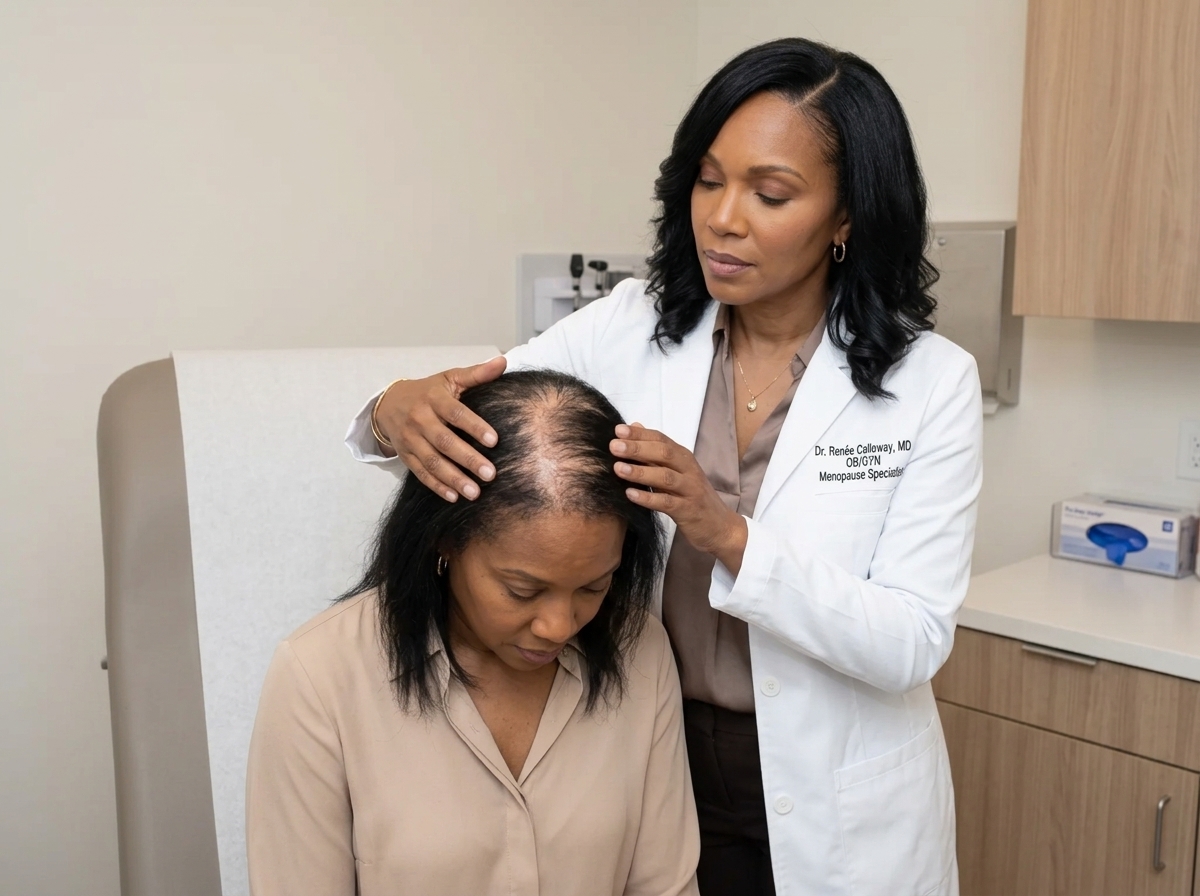
There's one patient I will never forget.
She was 53. The kind of woman who made a room feel calmer just by walking into it. The kind of woman you could tell had spent her whole life putting everyone else first.
She'd worn her hair natural for over 20 years. No relaxers. No heat. No tight styles — she hadn't worn one in years. Silk pillowcase every night. Satin bonnet without fail. She did everything right.
She came in with her phone already in her hand. She showed me a picture of herself from three years before. Full crown. Thick edges. The kind of hair other women stopped her to ask about.
Then she showed me what it looked like now.
And she started to cry. Not delicate tears. The deep kind. The kind that comes from going through something completely alone for a very long time.
She'd been to other doctors. Every one of them looked at her hair and blamed the styles she'd already given up years ago. Said the word menopause and nothing after it. Sent her home.
She caught her breath and she listed it all for me.
“Rosemary oil. Castor oil. Black castor oil. Biotin. Iron. Vitamin D. Collagen. I changed my whole diet. I tried minoxidil until it started growing hair on my face and I had to stop. I've spent more money than I want to say out loud.”
“I haven't worn a tight style in years. No heat. No relaxers. I deep condition every week. I protect it every single night.”
“I have done everything right. And I'm still sitting here watching it disappear.”
Then she said something I've never been able to forget.
“I grew up where ‘bald-headed' was the worst thing you could call a woman. I never thought it would be me. I hate looking in the mirror. I hate touching my own hair. And I don't know what else I'm supposed to do.”
I handed her a tissue. I told her menopause is hard on the body in ways no one prepares us for. That she was doing everything right.
And then I told her the exact same thing I'd told a hundred Black women before her.
Let's check your labs. Try to manage your stress. Come back in six months.
She nodded. She wiped her face. She thanked me. She left.
And I called in my next patient.
It Came For Me
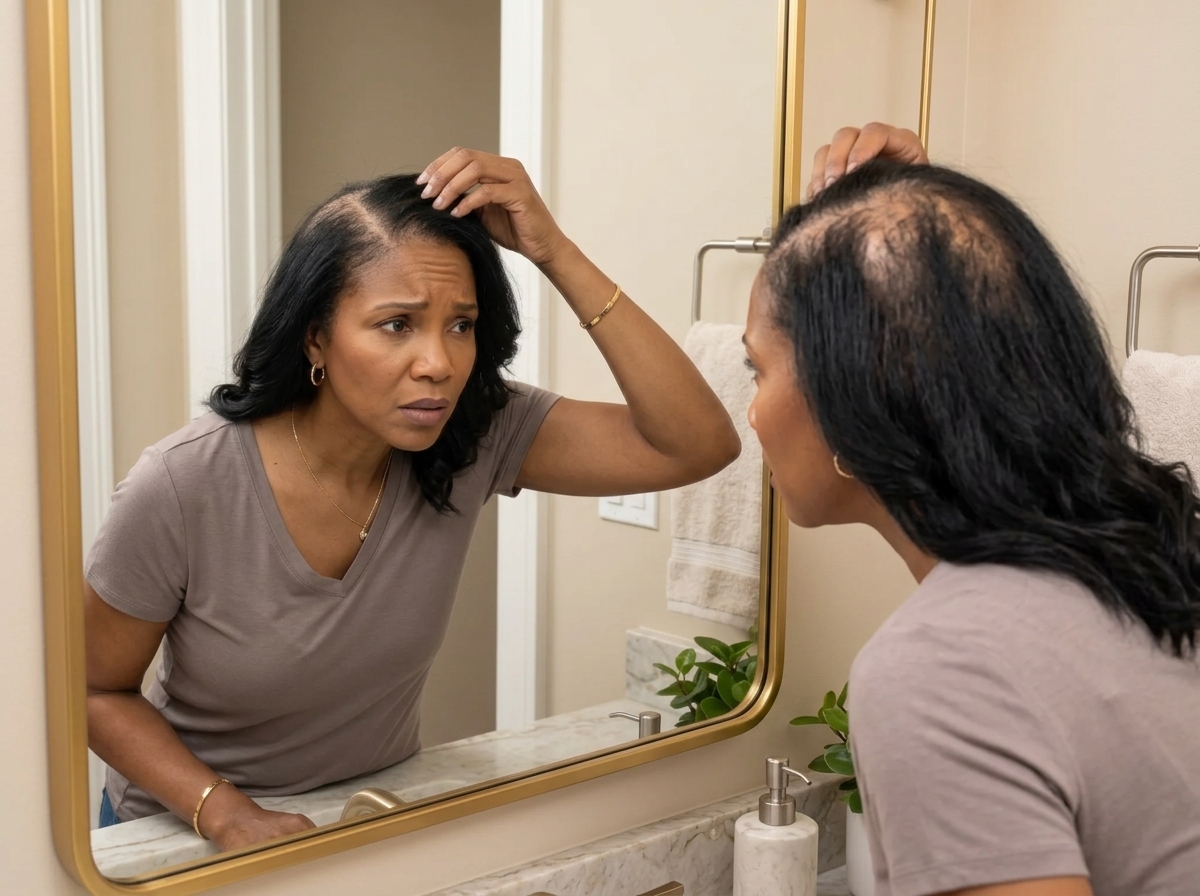
About six months later, the thing I'd been dismissing in my office for 20 years came for me.
At 47, I entered early menopause.
It started the way it always does. A little more on the pillow. A part that looked a little wider in the mirror. Hair on my collar I told myself was nothing.
I told myself exactly what I'd told them. Some shedding is normal. It's hormones. It'll settle.
It didn't settle.
Then one morning, in the shower, I looked down at my hands. More hair than I had ever seen come out of my head at one time.
I stood there holding it and I broke down. Right there, alone, in the shower. The exact way my patients had described to me for 20 years — the way I had never once understood until that morning.
Within eight months my crown was thinning. My edges were pulling back. The hair I had carried and protected for over 40 years was leaving me.
So I did what any doctor would do. I started with biotin. Then iron and vitamin D. I changed my HRT thinking it was a dosage problem. And finally I did the thing I'd always hesitated to do — I wrote myself a minoxidil prescription, because I knew what it really meant. A lifetime commitment. You stop, you lose everything you gained. And the dread shed before you ever see a result.
It did nothing.
So I called my own colleagues in dermatology. The specialists. The people I had been referring my patients to for 20 years.
And I heard my own words come right back at me. Some thinning after menopause is normal. Your labs look fine. Try to manage your stress.
I was a Black woman. A physician with 20 years of experience. A menopause specialist. And I had no answer for what was happening to my own body.
But that wasn't even the part that cut the deepest. The part that cut the deepest was thinking about her.
The woman who had sat across from me six months earlier. Who showed me photos of the hair she used to have. Who listed everything she'd tried and everything she'd spent and looked at me and said she didn't know what else to do.
And I had handed her a tissue and told her it was normal.
Then I thought about the woman before her. And the one before her. And the one before her.
Black women who had come to me as their last real hope — because if a Black menopause specialist couldn't help them, who could — and who had left my office feeling exactly the way I now felt sitting in it.
I had managed every other symptom of their menopause for 20 years. Their hormones. Their hot flashes. Their sleep. Their bones. I had never once researched what menopause was actually doing to their hair.
Not once. In 20 years.
That wasn't their failure. That was mine. And I was not going to let it stay that way.
The Investigation

So I did what I should have done two decades earlier. I blocked off my schedule. I sat down with every hormonal and dermatological database I had access to. And I stopped asking the question I'd always asked — what treats hair loss in women — and started asking the one nobody had ever asked me to answer.
What does menopause specifically do to a Black woman's hair?
For the first few days, I found almost nothing. Because almost nothing existed. The research on female hair loss was built almost entirely around white women. The research on Black women's health barely mentioned hair at all.
That absence told me everything.
Then I started pulling the pieces, and they came together into three forces — three separate attacks, hitting the same scalp at the same time. And every product my patients had ever tried, every treatment I'd ever recommended, was built to fight one of them at most. Usually none.
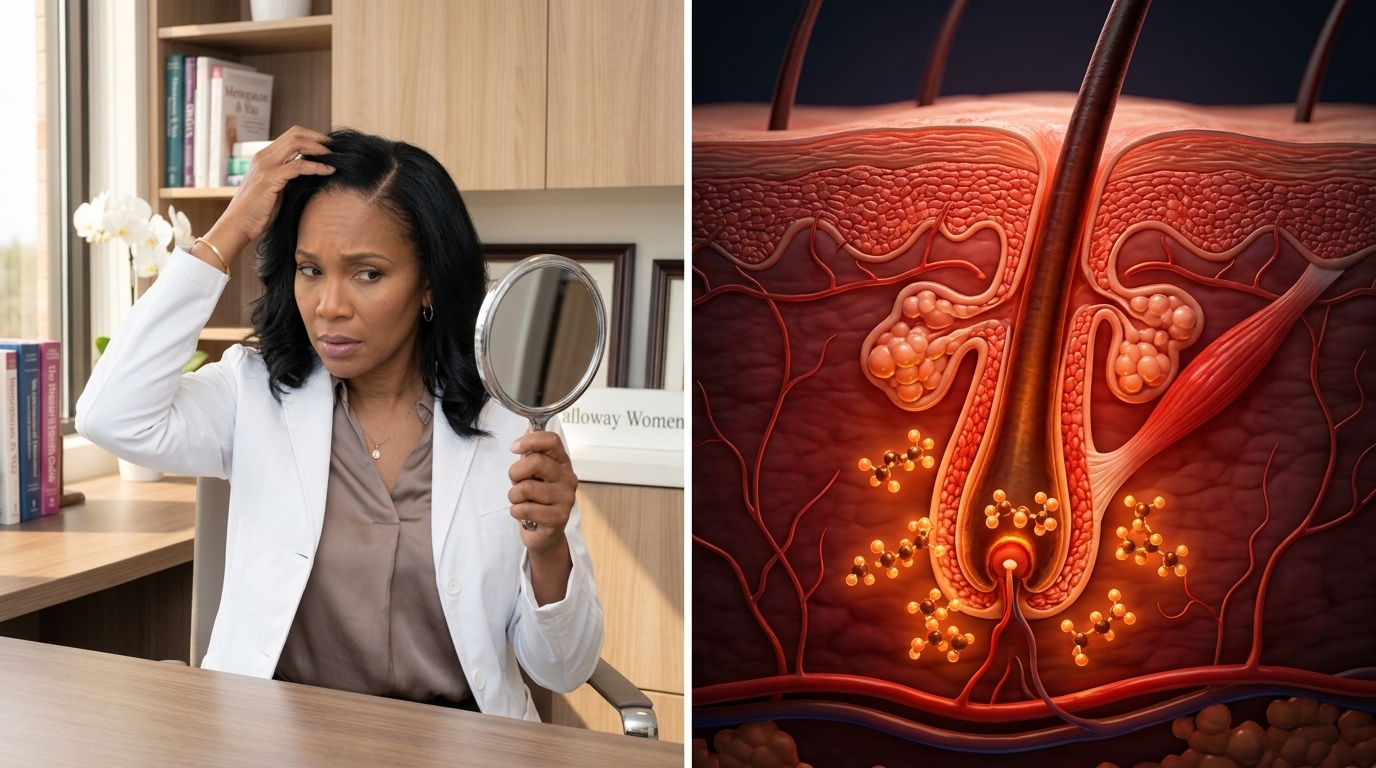
Force One — the DHT surge. As estrogen drops in menopause, the balance tips toward DHT, a potent androgen that wraps around the follicle, chokes off its blood flow, and slowly shrinks it until it goes dormant. In men it's the engine of pattern baldness. In a menopausal woman it does the same thing — quietly, at the crown, the part, and the edges first.
Force Two — the legacy damage. Here's what no protocol built for white women ever accounted for: a Black woman's follicles don't arrive at menopause healthy. Years of relaxers, heat, tension, and protective styling leave them inflamed and weakened long before the hormones ever shift. So when DHT surges, those follicles were already losing the fight. Other women's follicles arrive strong enough to weather it. Yours — through no fault of your own — arrive compromised.
Force Three — the scalp in crisis. Estrogen was the thing maintaining your scalp's oil, its barrier, the whole environment hair needs to grow. When it drops, that barrier breaks down. The scalp gets inflamed, depleted, hostile to new growth. For most women that's serious. For a Black woman whose scalp was already stressed by decades of chemical services, it's the ground itself turning against the seed.
Three forces. All three at once. And nothing on the market — not the oils, not the supplements, not minoxidil — was ever built to fight more than one.
The DHT Surge
As estrogen declines, your body tips toward DHT — the same androgen behind male pattern baldness. It wraps around your follicles and starves them of the blood flow they need to survive. Your follicles aren't dying. They're being suffocated.
Decades of Legacy Damage
Relaxers. Heat. Tension. Years of low-grade inflammation that weakened your follicles long before menopause arrived. Other women's follicles reach menopause strong. Yours reached it already compromised — and nothing was ever built for that specific reality.
A Scalp in Crisis
Estrogen kept your scalp's barrier and oil intact. Without it, the scalp becomes inflamed, depleted, and hostile to growth. For a Black woman whose scalp arrived already compromised, the ground itself stops supporting the hair.
Building the Answer — Force by Force

Once I understood the three forces, I knew what I was looking for. Not one ingredient for hair in general. A system — one thing for each force, at the strength the studies actually used.
For Force One, I needed to block the DHT. I went to the botanical research and kept coming back to saw palmetto — a plant extract shown to help block the enzyme that converts testosterone into DHT in the first place. Cut the conversion, and you ease the strangle on the follicle. No prescription. No facial hair. No dependency.
For Force Two — the rebuilding — was where everything else on the market quit. This is the force I cared about most, because it's the one that's specific to us, and it's the one nobody addresses. You can block the hormone all day long, but if the follicle is already damaged from decades of relaxers and tension, blocking alone leaves it broken. It needed to be rebuilt.
That's where I found the part that changed everything: five bioactive peptides (sh-Polypeptide-1, -9, -11, and sh-Oligopeptide-2, -10). These are biomimetic signal peptides — they mirror the body's own growth signals and essentially tell a worn-down follicle to repair and strengthen itself. This is the rebuilding step. The one oils don't have. The one sprays skip. The one even minoxidil can't do.
I paired the peptides with Baicapil — a botanical complex of soybean germ, wheat germ, and Scutellaria baicalensis — because of its published six-month study showing more hair shifted back into the active growth phase and less shedding over the same window. The peptides rebuild the follicle; Baicapil wakes it back up.
And none of that matters if it can't get in. So I insisted on a liposome delivery system — the actives encapsulated so they actually penetrate the scalp barrier and reach the follicle, instead of sitting on the surface the way every greasy oil my patients had tried always did.
For Force Three, I needed to calm the scalp and make it grow-able again. I brought in rosemary extract — which in a six-month trial matched 2% minoxidil for hair count, with less scalp itching — and eucalyptus and soothing botanicals to calm the chronic inflammation decades of relaxers and heat leave behind.
Three forces. Three jobs. Block the hormone. Rebuild the follicle. Calm the scalp. And for the first time, all three in one bottle.
The Formulation Fight

Knowing what should be in it and getting someone to make it correctly turned out to be two very different things.
The first lab told me the peptide concentration was too high and offered to cut it. I said no. The second wanted to swap the Baicapil for something cheaper. I walked. The third told me a dropper serum was harder to formulate with this many actives than a simple oil or spray — couldn't I just do an oil?
I told them that was the whole point. My patients had spent years putting heavy, greasy oils on their scalps that never absorbed and never reached the follicle. I wanted something light. Colorless. Something that disappeared into the scalp in seconds and got the actives where the damage actually was.
It took months and more “no”s than I want to count before I found a lab that would build my exact formula with zero compromises. Full peptide concentration. Real Baicapil. The liposome delivery intact. Complete transparency on every ingredient — which is why, to this day, all five peptides are named right on the box. Nothing hidden behind “proprietary blend.”
The day the first bottles arrived, I opened the box and just looked at them for a while. Something that should have existed 20 years earlier. Finally real.

But I didn't send it to a single patient yet. I wasn't going to hand the women I'd already failed once another promise. Not without being certain. Not without living it myself first.
The Self-Test
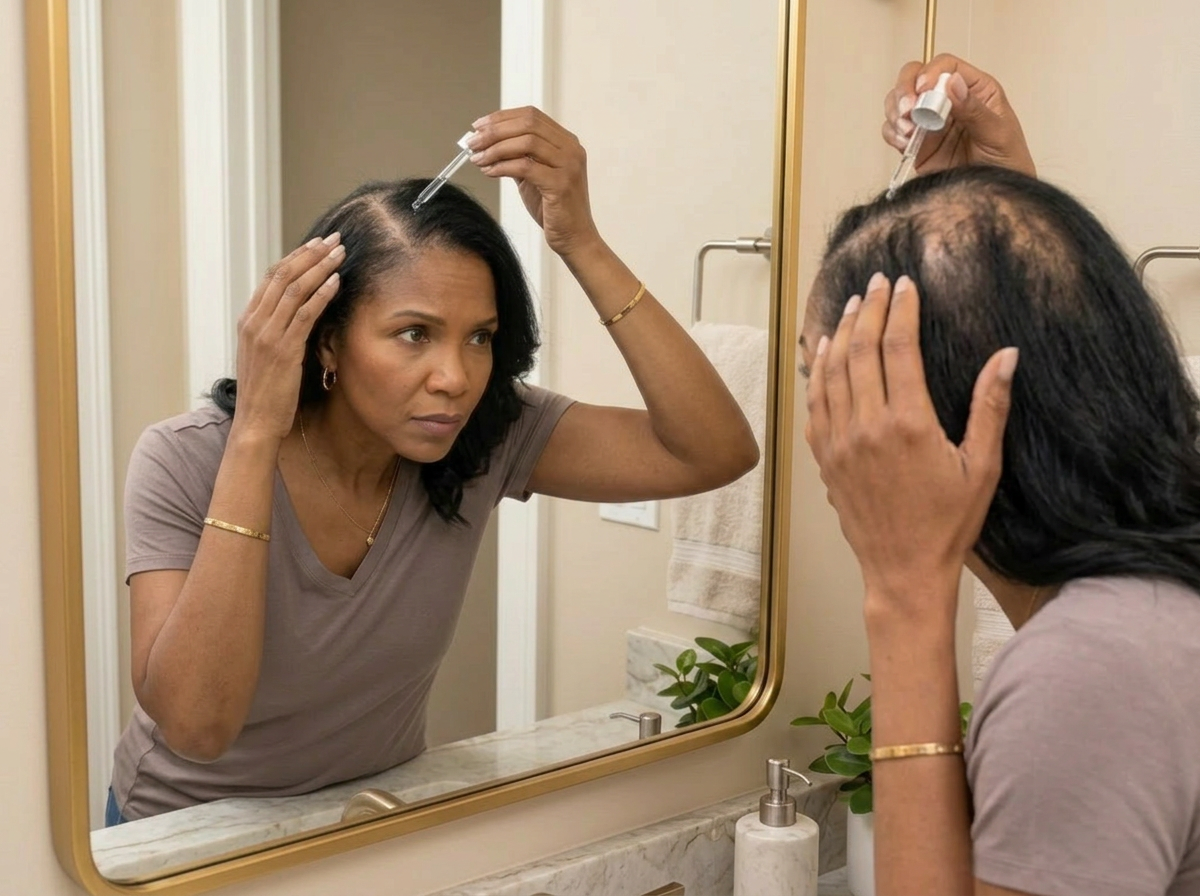
Every night before bed, I parted my hair and put a few drops directly on my scalp — the crown, the part, the edges. Sixty seconds. Then I let my scalp do its deepest repair work overnight, while I slept.
And I tracked everything. The hair in my drain. The width of my part. A photo, every single week, in the same light.
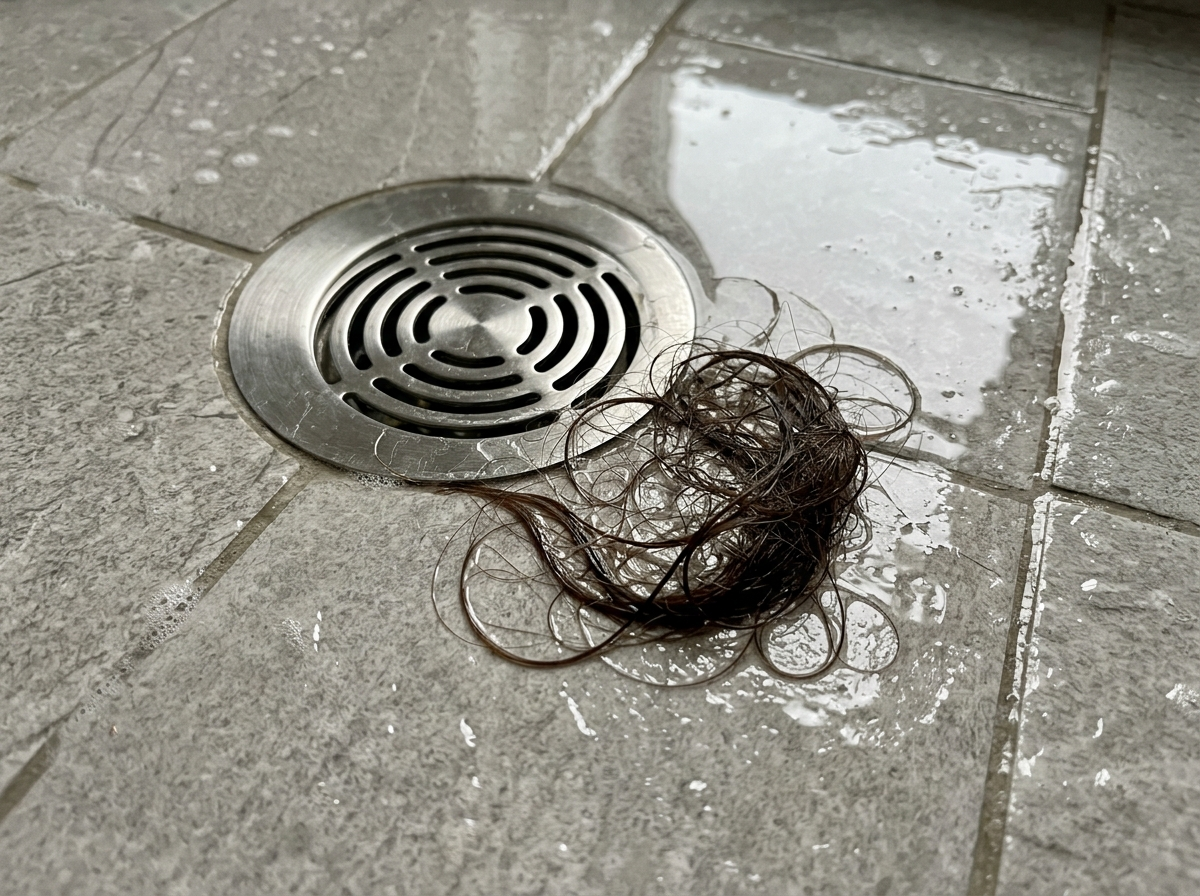
Week four. Wash day. For over a year I'd dreaded it. That morning I braced for the clumps the way I always did. And for the first time, I genuinely couldn't tell if I was imagining it — or if there was actually less. I counted twice. I told myself it was probably nothing. I'd been hopeful before. I took the photo and kept going.

Week eight. I was running late, leaning into the mirror to put in an earring, and that's when I saw them. Baby hairs along my part. Small, but undeniably there — where there had been nothing for over a year. I pulled up my week-one photo and held it next to the mirror. Different. My hands were shaking.
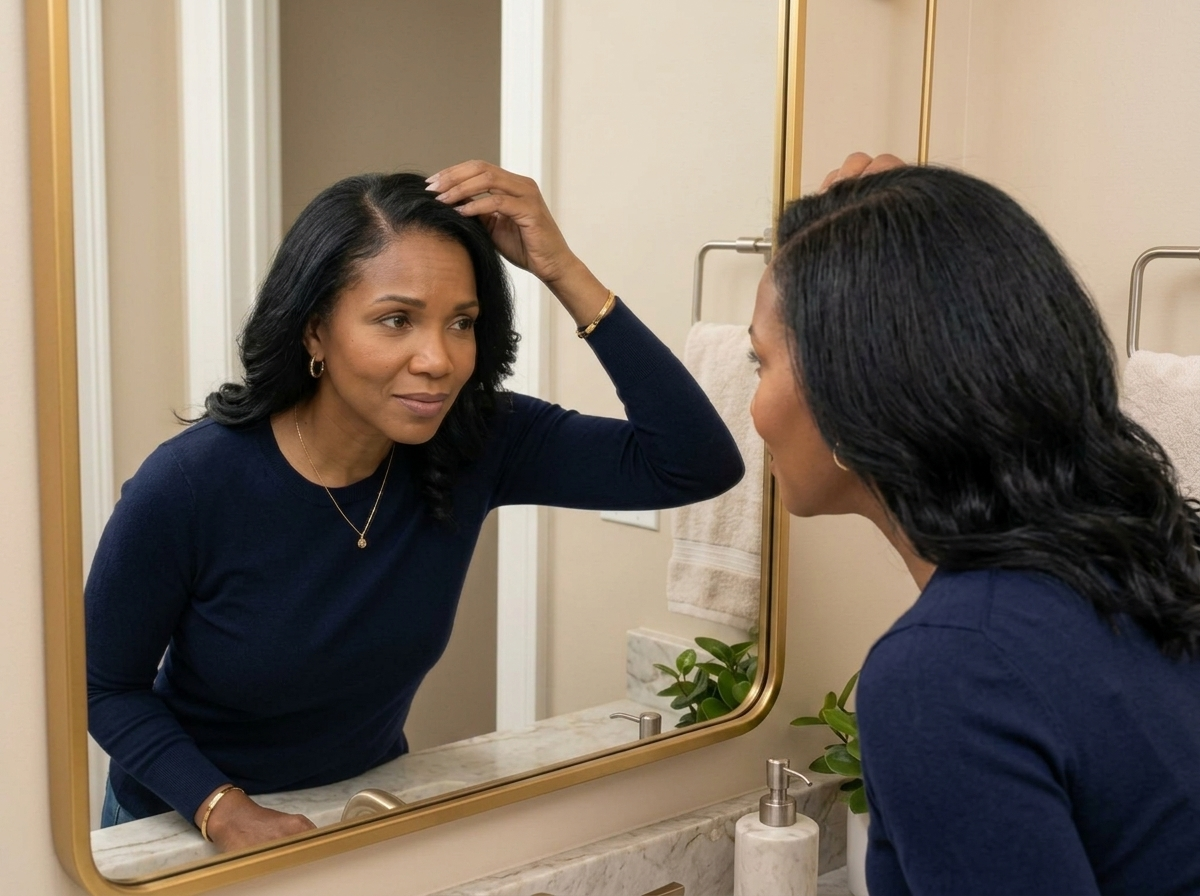
Week twelve. I'd stopped bracing myself in the mornings. My part — the one that had been widening every week while I covered it and pretended not to notice — was tighter. My crown was visibly fuller. My edges, the ones I'd quietly accepted were gone, were coming back. I took my photo, pulled up week one, and sat with the two of them for a long time. The woman in those two pictures was not the same woman. And the tears that came weren't from pain anymore.
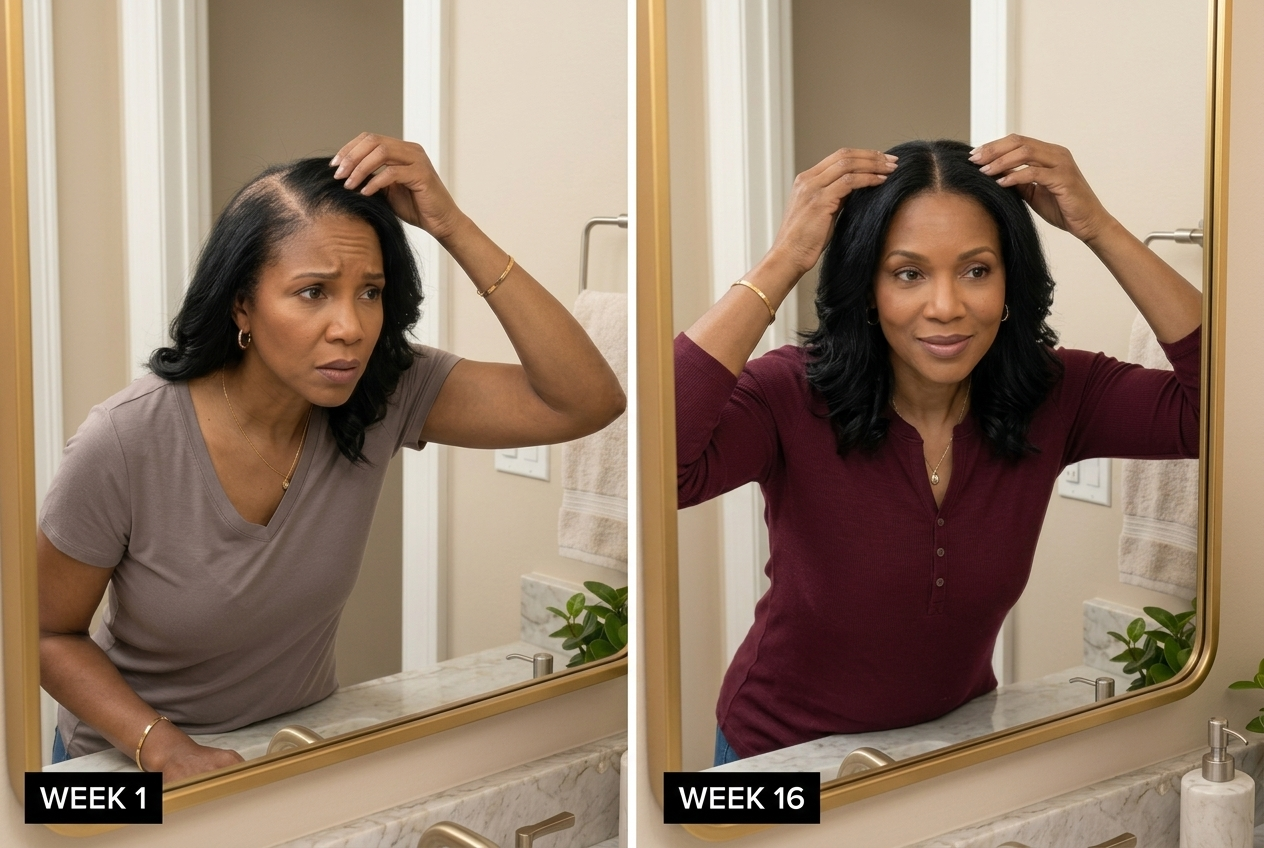
Week sixteen. My crown was full. Not perfect — real results take time — but visibly, undeniably fuller than it had been in over a year. My edges were back. My hairline was back. For the first time since this started, I got ready in the morning in my own hair, as myself, and I felt like me.
It had worked. On me. Which meant it could work for them.
The Redemption

The first call I made was to her. The patient who had broken down in my office because she'd tried everything and nothing had worked.
“I owe you an apology,” I told her. “When you came to me, I gave you the same answer I'd been giving everyone for 20 years. I sent you home without a real answer, because I didn't have one. I only went looking for the real one when it started happening to me.”
I told her what I'd found. The three forces. Why everything she'd tried had failed. And the thing I'd built because nothing that existed was ever made for this.
“I tried it on myself first. Sixteen weeks. It changed everything. I'd like to send it to you — not as your doctor prescribing something, but as a woman who owes you better than what she gave you the last time you sat in that chair.”
She was quiet for a moment. Then: “Okay. I'll try it.”
I didn't follow up. I knew this woman. I knew what it took to put the last of your hope into one more thing. I gave her time.
Eight weeks later she walked into my office. Not for an appointment. She just walked in. And I saw her face before she said a word.
She sat down across from me and started to cry. I handed her a tissue. This time it meant something completely different.
“I went to work yesterday in my own hair. Nobody knew how big that was except me.”
It Had to Exist for Everyone

“I'd been putting off wash day for as long as I could — sometimes a month — because every time I washed my hair I'd find clumps and just stand there crying. Six weeks in, the drain was almost empty. By week eight my crown was filling in and my part was tighter. I sent my daughter a picture without a word and she called me back in two minutes screaming. I look forward to wash day now. I never thought I'd say that again.”

“My edges had been gone so long I stopped checking them. I'd accepted that chapter was over. Around week six I caught something in the mirror, leaned in — baby hairs, right along my hairline where there'd been nothing for years. I called my sister and just cried.”

“I'd given up. I stopped doing anything to my hair because I couldn't look at it. The day I saw my crown filling back in, I sat down on the floor — not because I was sad, but because I'd stopped believing it was possible, and it was happening anyway.”
These were women I had access to. But I kept thinking about every Black woman in menopause who didn't have a doctor who'd done this research for her. Who was still sitting exactly where my patients had been. Alone. Dismissed. Trying everything. Getting nowhere.
So I made it available to everyone.
That Formula Became CERA Root Revival Serum
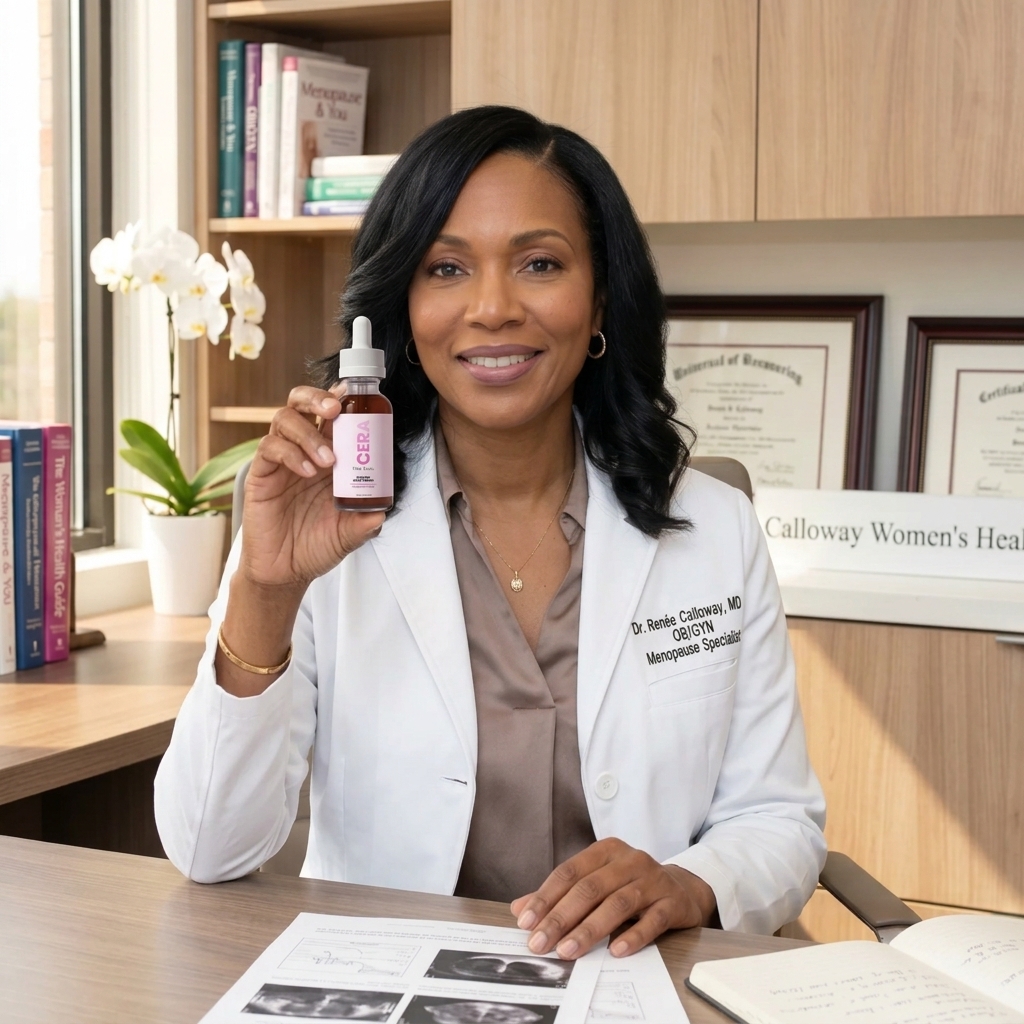
The first peptide serum built specifically for the three forces attacking a Black woman's hair in menopause. Not for thinning hair in general. For this.
Block the hormone
Saw palmetto helps stop DHT from strangling your follicles.
Rebuild the follicle
The step everything else skipsFive bioactive peptides — backed by Baicapil and carried in by liposome delivery — rebuild what decades of relaxers, heat, and tension wore down.
Fix the scalp
Rosemary and soothing botanicals restore the scalp so everything else can actually work.
One dropper. Three pillars. Sixty seconds a night. No pills. No grease. No synthetic hormones. No minoxidil. No lifetime dependency. No dread shed.
Built on Real Clinical Evidence
Figures come from published studies on CERA's key actives at studied concentrations, and on menopausal hair loss. Individual results vary.
If You're Reading This, I Want to Talk to You Directly
Not as a doctor. As a woman who lived exactly what you're living.
If you've been natural for years and still watched your crown disappear. If you've tried the rosemary oil, the castor oil, the biotin, the Nutrafol, the minoxidil — and none of it worked. If you've sat in a doctor's office and been told a little thinning is just part of menopause.
If you dread wash day. If you avoid mirrors. If you put on a wig every morning and get complimented on hair that isn't yours. If you've quietly started to wonder if you're just one of those women whose hair is never coming back —
You're not. You were never the problem. You were just never given anything built for what you're actually going through.
CERA was built for you. For your hormones. Your history. Your hair. For the three forces nothing else was ever made to fight.
I know what you're thinking, too — because I recommended most of the things that failed you. You've been here before. A new bottle. A new promise. The same disappointment. So I'm not going to ask you to believe me. I'm going to ask you to test me.
This Is Our 10th Batch
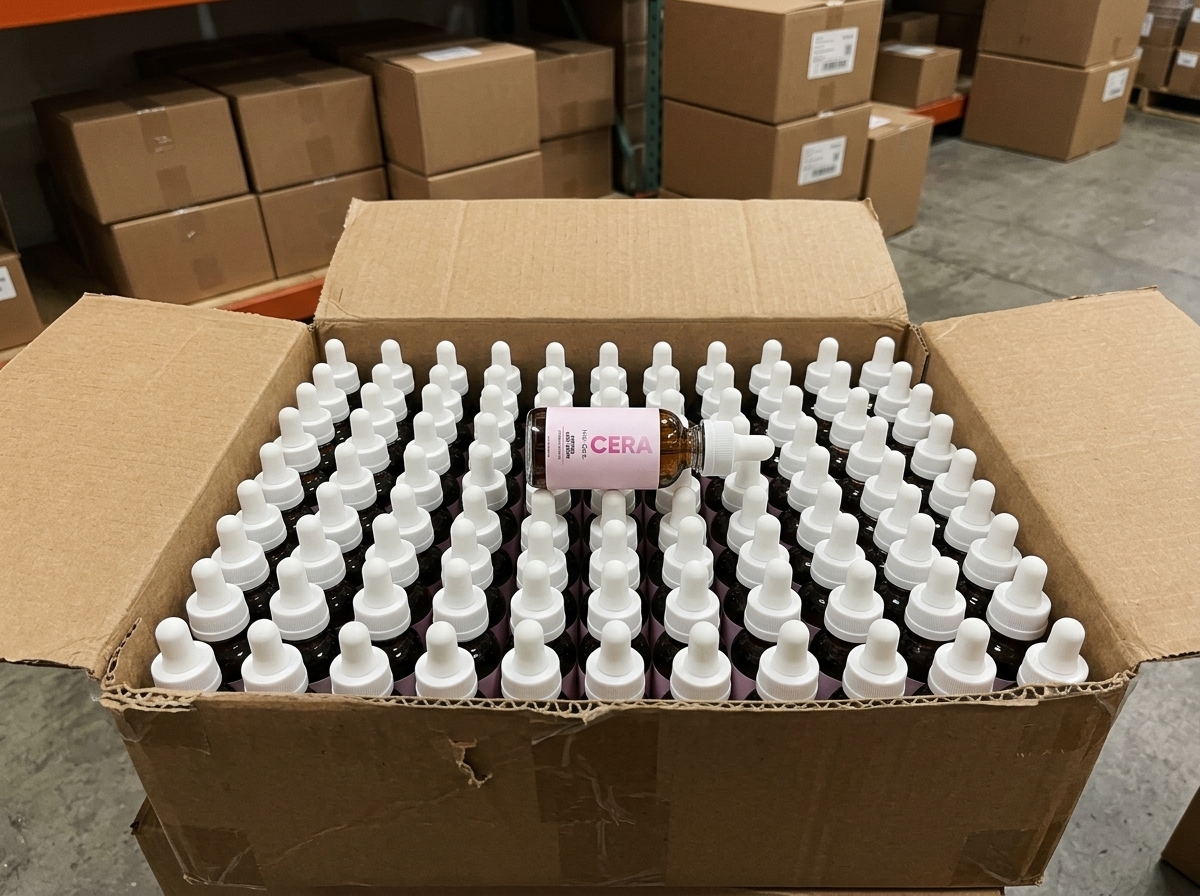
I never planned a big launch. I sent one note to my patients. Word moved from them to women who'd never set foot in my office — in the group chats, the Facebook groups, the same places Black women in menopause had been searching for answers for years. Except this time they weren't asking for help. They were sharing something that was working.
Every batch we make sells through faster than the last. Each one takes time to produce at the full concentrations the formula demands, with zero compromises — which means every time a batch sells out, the next one is weeks away.
This is our 10th batch — 2,000 bottles total. When it's gone, the next batch won't be ready for three months.
- ✦ Free U.S. Shipping on every order
- ✦ 120-Day Results-or-Refund Guarantee
And you can try it completely risk-free for 120 days. I'm that sure of what I built. Use every drop. If you don't see a difference in your shedding, your edges, or your crown, contact us and we'll refund every penny. No forms. No hoops. No questions.
Right Now You Have a Choice
You can keep doing what you've been doing. Dreading wash day. Finding clumps in the drain and saying nothing to anyone. Putting on a wig you hate and accepting compliments on hair that isn't yours. Trying the next thing that promises everything. Wondering if you're just one of those women whose hair never comes back.
Or you can test the one thing that was actually built for what you're going through — for 120 days, risk-free, with every penny back if it doesn't work.
Sixty seconds a night. And the first real chance your follicles have ever had.
Your follicles aren't dead. They're waiting.
Give them what they've never had before.
With love — and with the apology I owe every woman I sent home with the wrong answer.
Live Inventory: 37 bottles remaining. NOTE: CERA is only available through our official website. Not sold on Amazon or eBay. Beware of imitations.